
Published: February 2026 | Theme: Valentine’s Day & National Pet Heart Health Month
Forget the candlelite dinners and boxes of chocolates.
This February 14th, the most meaningful thing you can do for your four-legged soulmate is to care for their ticker.
It’s Annual Doggie Date Night, and with February also marking National Pet Heart Health Month, there’s no better time to focus on the organ that quietly keeps your dog alive—every single second.
We talk endlessly about glossy coats, ideal weight, and perfect poop. But the heart? It works in silence. Until it doesn’t.
From understanding subtle signs of heart disease to navigating the anxiety around puppy heart murmurs, being a responsible dog parent means moving beyond treats—and getting into the rhythm of cardiac care.
The Anatomy of Puppy Love: Why Heart Health Matters
Just like humans, dogs are vulnerable to cardiovascular disease. And just like humans, it rarely announces itself loudly in the beginning.
Whether you live with a Toy Poodle or a Great Dane, the heart’s job never changes: pump oxygenated blood to every muscle, organ, and cell.
The challenge? Dogs are exceptionally good at masking discomfort.
Many cardiac conditions progress quietly for months—or even years—before obvious symptoms appear. By the time pet parents notice something is “off,” the disease may already be advanced.
That’s why regular cardiac screening and intentional movement aren’t optional add-ons. They’re foundational.
Did you know? Roughly 1 in 10 dogs seen by primary-care veterinarians have some form of heart disease. The risk increases sharply with age.
Understanding the Early Signs: What to Watch For
Before planning your Doggie Date Night workout, start with awareness.
Heart disease rarely starts with collapse. It starts with changes so subtle they’re easy to dismiss.
Common Early Red Flags
- Persistent cough – often worse at night or when lying down
- Reduced stamina – walks that used to excite now exhaust
- Fainting or weakness – brief collapses, especially after exertion
- Breathing changes – faster or labored breathing at rest
- Abdominal swelling – fluid buildup from inefficient circulation
None of these signs alone confirm heart disease—but together, they deserve attention.
A Word on Puppy Heart Murmurs
For new dog parents, hearing the phrase “heart murmur” during a puppy check-up can be terrifying.
A murmur is simply an extra vibration or “whooshing” sound between heartbeats.
Many puppies have innocent murmurs that resolve naturally by 4–6 months as the heart matures.
Others, however, may signal congenital heart defects that benefit enormously from early diagnosis.
The key isn’t panic. It’s follow-up.
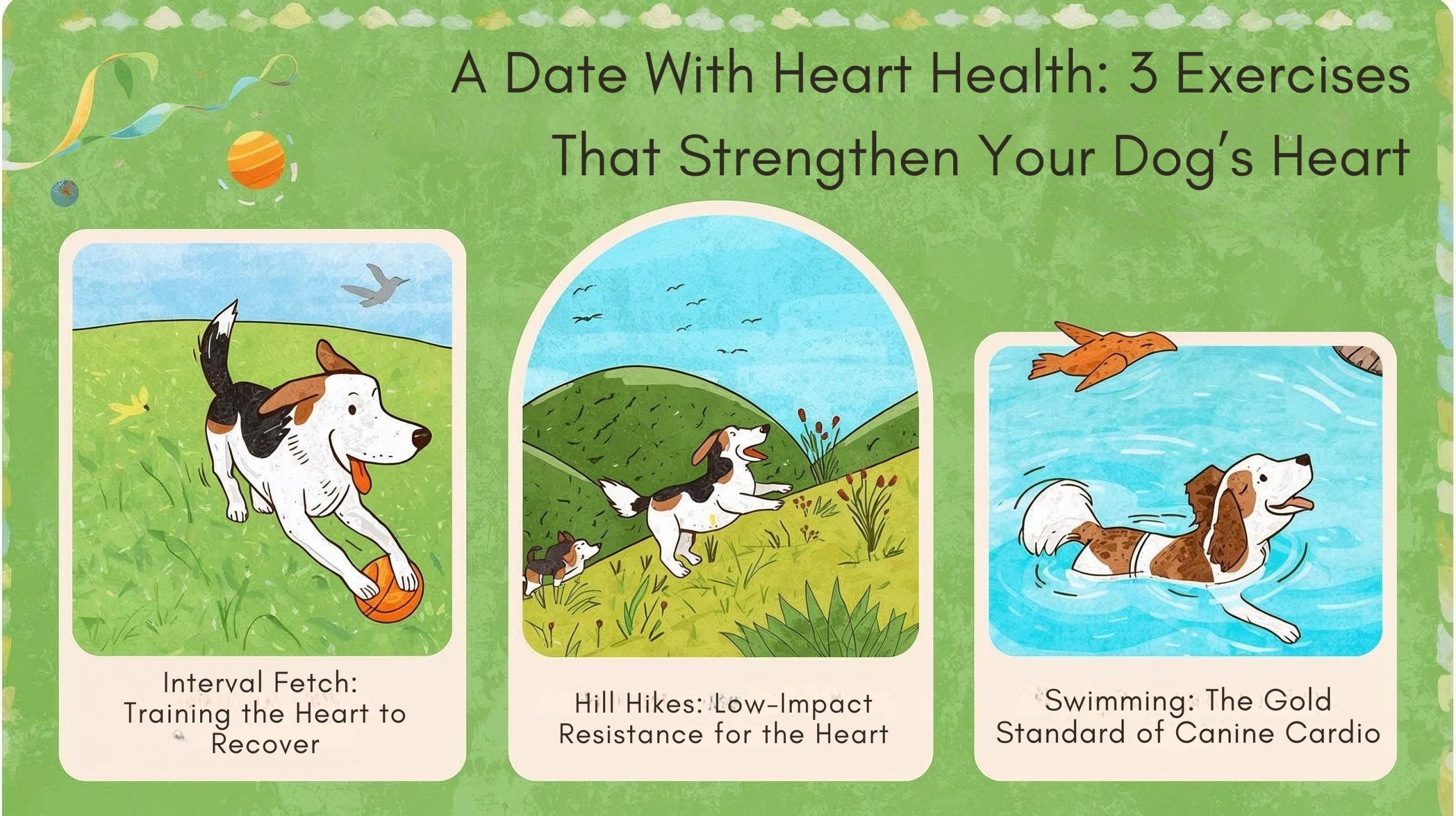
The Doggie Date Night Workout: 3 Heart-Strengthening Exercises
A strong heart isn’t built through random bursts of play alone.
Cardiac fitness comes from structured aerobic activity—movement that gently challenges the heart to pump more efficiently over time.
Here are three vet-approved “dates” you can plan this month to support your dog’s cardiovascular health.
1. Interval Fetch: Training the Heart to Recover
Fetch is already a favorite. But with one small tweak, it becomes a powerful cardiac workout.
The Date:
Head to a park or open area. Play fetch at high energy for 3–5 minutes. Then switch to a slow, relaxed sniff-walk for 2 minutes. Repeat 2–3 cycles.
Why It Works:
This mimics interval training in humans. The heart learns to:
- Increase output efficiently
- Recover faster after exertion
- Improve oxygen delivery to muscles
It’s especially beneficial for young adult dogs with high energy but poor endurance.
2. Hill Hikes: Low-Impact Resistance for the Heart
Flat walks are fine. But inclines change everything.
The Date:
Choose a trail or neighborhood route with gentle elevation. Maintain a steady pace—no sprinting.
Why It Works:
Uphill movement forces the heart to pump harder to supply oxygen to the powerful hind-leg muscles.
- Builds endurance
- Strengthens cardiac output
- Minimal joint impact when done slowly
This is ideal for medium-to-large breeds and dogs who aren’t natural runners.
3. Swimming: The Gold Standard of Canine Cardio
If your dog enjoys water, nothing beats swimming.
The Date:
Visit a dog-friendly pool, hydrotherapy center, or calm shallow water. Always supervise.
Why It Works:
Water provides resistance without impact.
- Strengthens the heart
- Protects joints
- Improves circulation
Swimming is particularly valuable for:
- Senior dogs
- Dogs with early heart disease
- Dogs with arthritis or mobility limitations
Play or Pause? Matching Activity to Life Stage
| Dog Profile | Recommended Activity | Primary Focus |
|---|---|---|
| Puppies (<1 year) | Short play bursts, social walks | Monitoring murmurs & development |
| Healthy Adults | Hiking, swimming, interval fetch | Maintaining cardiac efficiency |
| Seniors (7+ years) | Slow scent walks, gentle swimming | Comfort, circulation, observation |
Don’t Guess: Make Cardiac Screening Part of the Date
Exercise strengthens the heart—but screening protects it.
During a routine wellness exam, your vet will perform auscultation, listening for murmurs or rhythm changes.
If something sounds unusual, further diagnostics may include:
- Chest X-rays – heart size and fluid assessment
- Echocardiogram – real-time valve and chamber function
- EKG – electrical rhythm evaluation
Early detection doesn’t just extend life—it improves quality of life.
👉 Book an online vet consult with MyFurries to discuss heart health, murmurs, or exercise safety for your dog.